How Short-Term Rental Platforms Are Hollowing Out Small Towns — And Where Conscious Travelers Book Instead
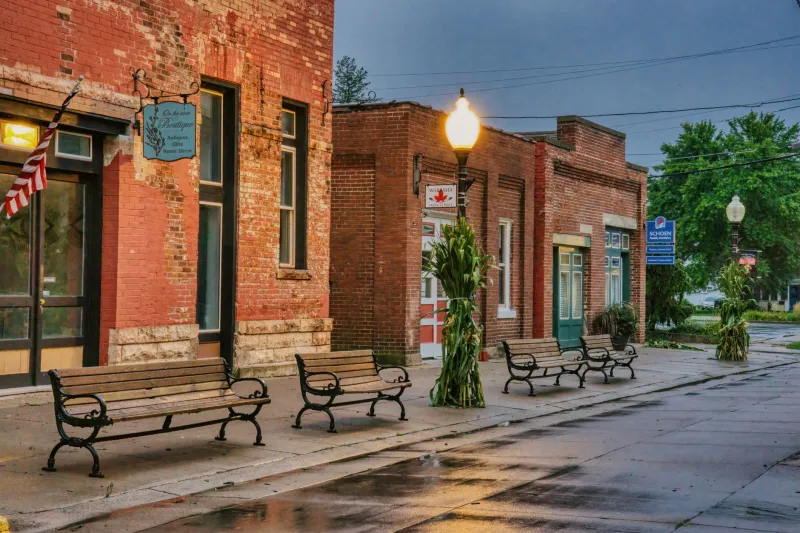
Picture a town you love. Maybe it's a coastal village in Maine, a ski-adjacent mountain community in Colorado, a quirky arts town in the Texas Hill Country. You've driven through it, maybe stayed there once, maybe dreamed about living there. It has a good coffee shop, a bookstore that somehow survives, neighbors who wave at each other from front porches.
Now picture what happens when that town becomes a destination.
Not immediately — the change is gradual. A few houses go up on the big rental platforms. Then a few more. Investors from out of state start buying up properties specifically to rent them short-term, because the math pencils out so much better than a long-term lease. The local teacher who's been renting the blue house on Elm Street for six years gets a notice: the landlord is converting. So does the nurse. So does the guy who runs the bookstore.
This isn't a hypothetical. It's a documented pattern playing out in communities across the country, and it's accelerating.
The Numbers Behind the Displacement
Research from the National Bureau of Economic Research found that a 10 percent increase in Airbnb listings in a neighborhood correlates with roughly a 0.4 percent increase in rents and a 0.76 percent increase in home prices. Those percentages sound small until you're the person who can no longer afford to live in the town where you grew up.
In Sedona, Arizona — one of the most Instagrammed small towns in America — more than 30 percent of all housing units are listed as short-term rentals at any given time. In some neighborhoods, it's closer to half. The people who work at the restaurants and shops that make Sedona worth visiting increasingly can't afford to live there. They commute from an hour away. Or they leave.
Jackson, Wyoming. Telluride, Colorado. Fredericksburg, Texas. Bar Harbor, Maine. The pattern repeats with eerie consistency: a beloved small town becomes a destination, the short-term rental economy inflates housing costs, the working residents who give the town its character are priced out, and slowly the place becomes a kind of theme park of itself — all the aesthetics, none of the soul.
"We've lost three teachers in two years because they couldn't find housing," says a city council member in a small coastal Oregon town who asked not to be named. "The irony is that people come here because it feels authentic. But we're losing the people who make it authentic."
What the Big Platforms Get Right — and What They Ignore
To be fair, short-term rental platforms didn't invent the housing crisis. Zoning laws, underbuilding, and speculative investment all predate them. And for individual homeowners renting out a spare room or their primary residence while they travel, these platforms have been genuinely useful.
The problem is that the economics of the platforms incentivize scale. More listings mean more revenue. The algorithm rewards hosts who list multiple properties. And the platforms, which collect their cut regardless of whether a listing displaces a long-term renter, have limited financial motivation to self-regulate.
Some cities have pushed back hard. New York City's Local Law 18, which took effect in 2023, effectively banned most short-term rentals in buildings where the host isn't present — a move that removed tens of thousands of listings overnight. Similar restrictions have passed in New Orleans, Santa Monica, and dozens of other cities. But enforcement is uneven, and in smaller towns without dedicated housing departments, the regulations often lag years behind the problem.
What's Actually Different About a Homestay
Here's the distinction that matters: a homestay, in the truest sense of the term, is a primary residence where the host lives. They're not an absentee investor. They're not running a de facto hotel operation across five properties. They're a person who lives in their community, contributes to it, and is choosing to share their home with travelers in a way that keeps them rooted there.
When you book a genuine homestay with a resident host, your money doesn't flow to an out-of-state LLC. It goes to someone who will spend it at the local grocery store, the local hardware store, the local coffee shop. It helps them stay in a housing market that might otherwise force them out. And it keeps a real person in the fabric of a real community.
"I've been in this house for eighteen years," says Patricia, who hosts travelers in her Taos, New Mexico adobe. "The income I make from hosting is part of what lets me stay. Without it, I might have had to sell and move somewhere cheaper. Instead, I'm still here, still part of this neighborhood."
How to Tell the Difference When You're Booking
Not every listing on a major platform is an extractive investment property, and not every independent booking site is inherently virtuous. The key is asking the right questions before you book.
Does the host live there? A listing where the host is present — or at minimum, where the property is their primary residence — is categorically different from a whole-home investment rental. Look for language in the listing that indicates this. Ask directly if you're not sure.
Is there a personal touch? Listings run by property management companies tend to feel transactional — stock photos, generic descriptions, automated messaging. A host who lives in and loves their community will usually show it.
Who owns the property? This is harder to determine, but worth researching for longer stays. County property records are public in most states. If the owner is an LLC with a generic name, that's a signal.
What does the neighborhood look like? Tools like AirDNA and Inside Airbnb (a public data project) let you visualize short-term rental density in a given area. If half the block is on the platform, you're staying in a neighborhood that's already been significantly altered.
Redirecting Your Travel Dollars
Conscious travel isn't about guilt. It's about paying attention to where your money goes and making choices that align with what you actually value.
If you love small towns — if you seek them out specifically because they feel human and unhurried and real — then the way you book your stay matters to their survival. A traveler who spends $200 a night at a locally-owned homestay where the host lives, shops locally, and invests in their community is doing something meaningfully different from a traveler who spends the same amount at a whole-home rental owned by someone who's never set foot in the zip code.
The town you love exists because people chose to live there and stay there. The most conscious thing you can do as a visitor is make sure your presence helps them do exactly that.