When Words Fail, Everything Else Steps Up: The Unspoken Education of Homestay Travel
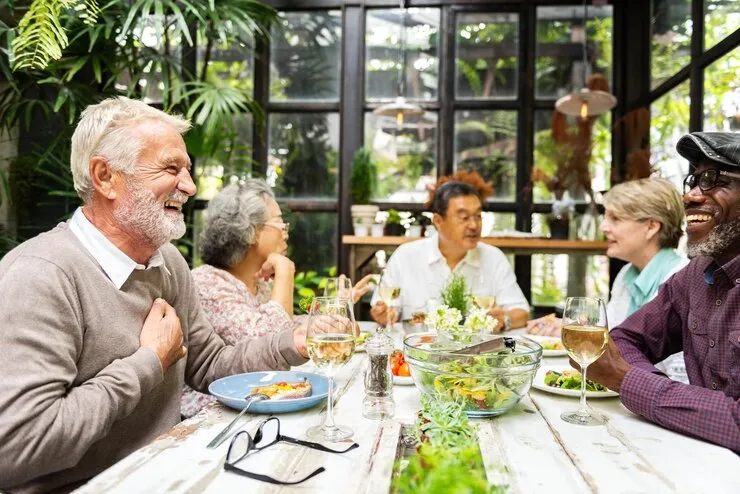
Photo: traveler and elderly host laughing together over shared meal across cultures, via img.freepik.com
The first time Kira tried to explain to her homestay host in rural Oaxaca that she was allergic to shellfish, she had exactly four words of Spanish and a very expressive face.
What followed was a ten-minute performance involving mime, a hand-drawn shrimp, a dramatic throat-clutching gesture, and a shared moment of genuine hilarity when her host produced a dictionary so old the pages had gone amber at the edges. They found the word eventually. Dinner was safe. And Kira — a quietly reserved graphic designer from Minneapolis who had always relied on language as her primary tool for navigating the world — discovered something unexpected.
She was, it turned out, a much better communicator than she'd thought. She'd just never had to prove it before.
The False Security of a Shared Language
Here's something most of us don't think about: the fact that we speak the same language as someone doesn't mean we're actually communicating with them. We talk past each other constantly — in offices, in families, in friendships. Shared vocabulary is a starting point, not a guarantee.
But when language fails completely — when you're sitting across a dinner table from someone whose words you cannot parse, whose cultural references you don't share, whose daily routines operate on entirely different logic — something interesting happens. You start paying attention in a different way.
You watch hands. You read faces. You notice posture, rhythm, the particular quality of a silence. You learn to distinguish the silence that means I'm thinking from the one that means I'm politely waiting for you to stop talking, from the one that means this moment is complete and doesn't need words.
This is not a skill most Americans get much practice with. We're a culture that values verbal fluency, that tends to fill silence with sound, that treats communication as primarily a linguistic exercise. The result is a kind of perceptual narrowness — we've outsourced so much of connection to language that we've let other channels atrophy.
Homestay travel, especially across language barriers, forces a recalibration.
The Friction That Teaches
It would be dishonest to make this sound entirely graceful. It isn't.
The misunderstandings are real, and some of them are genuinely uncomfortable. You eat something you didn't realize you'd agreed to eat. You show up dressed wrong for a meal that turned out to be more formal than you understood. You decline an offer that was, in context, an important gesture of welcome — and you don't realize your mistake until the slight has already landed.
These moments sting. But they're also, if you let them be, instructive in a way that nothing comfortable ever is.
Research in cross-cultural psychology suggests that what's called "cultural dissonance" — the friction of encountering norms and expectations that don't match your own — is one of the most powerful triggers for genuine perspective-taking. Not just knowing that other people experience the world differently, but feeling it, in the body, in the moment of confusion or embarrassment or unexpected delight.
A hotel insulates you from this. The design of commercial hospitality is, by definition, the removal of friction. The staff speak your language or close to it. The systems are familiar. The expectations are standardized. You move through the experience without being truly disturbed.
A homestay doesn't protect you from friction. It hands you the friction and says: here, figure this out.
What the Body Already Knows
There's a humbling discovery waiting for most American travelers who stay with families across language barriers: the body already speaks a language that needs no translation.
Offering food is an act of care in virtually every culture on earth. A hand on a shoulder means something. Laughter means something. The particular ceremony of making tea, or coffee, or whatever the local equivalent is — the attention given to a hot beverage prepared for a guest — communicates something about welcome that words would only flatten.
Derek, a high school history teacher from Columbus, Ohio, spent two weeks with a family in coastal Vietnam whose English extended to "good morning" and "thank you." He spoke no Vietnamese. "I thought it would be isolating," he says. "Instead, I learned more about human warmth in those two weeks than I had in years. The grandmother of the family — she and I barely exchanged a word the whole time, but she would find me every evening and hand me this specific tea she made. Every evening. I understood exactly what that meant."
This is what anthropologists have long called "phatic communion" — the communication that isn't really about information at all, but about connection. The small rituals that say you are here, I see you, you belong at this table. Language can carry this, but it doesn't have to. Sometimes it does the job better without.
Learning to Listen With More Than Your Ears
The travelers who describe homestay experiences as genuinely transformative often struggle to articulate exactly what changed. They reach for words like "opened" or "softened" or "slowed down." What they're usually describing, beneath those words, is a shift in perceptual attention.
When you can't rely on language, you start to read people. You get better at noticing when someone is uncomfortable, when they're delighted, when they're performing hospitality versus genuinely expressing it. You develop a sensitivity to context — to the way a room feels, to the meaning embedded in small gestures, to the difference between a smile that reaches someone's eyes and one that doesn't.
These are skills that transfer. People who've done this kind of travel often report that they come home and find themselves listening differently — more carefully, more fully, more attentively to what isn't being said. They become, in a quiet way, better at human connection across the board.
And that's not a small thing. In a culture that increasingly conducts relationships through screens and text, the ability to read a room — a real room, with real people in it — is becoming genuinely rare.
The Guest Who Arrives Speaking Nothing and Leaves Fluent in Something
Kira, back in Minneapolis, still has the hand-drawn shrimp. She keeps it in a drawer in her studio because it makes her laugh, but also because it reminds her of something she's tried to carry forward: that the most important conversations of her life haven't always been the most articulate ones.
"I used to think I wasn't good with people," she says. "I think what I actually wasn't good at was performing social fluency — the small talk, the easy patter. The homestay showed me that I'm actually pretty good at being with people. I just needed the words to get out of the way."
That's the strange, quiet gift that homestay travel offers — not a language course, but something older and more essential. The reminder that we were communicating long before we had words for it, and that the capacity for connection runs deeper than any language barrier can reach.
You just have to show up somewhere unfamiliar enough to find out.