From Farm Stand to Fork: The Real Environmental Cost of What You Eat on Vacation
You did everything right. You flew direct to cut down on emissions. You booked a locally owned homestay instead of a chain hotel. You brought your reusable tote and your bamboo toothbrush. And then you ordered DoorDash three nights in a row from a national chain restaurant eight miles away, wrapped in a tower of single-use plastic.
No judgment — it happens. Vacation brain is real, and delivery apps are frictionless by design. But food choices during travel stays are one of the most overlooked variables in the conscious travel equation, and they have a surprisingly direct impact on both your carbon footprint and the economic health of the community you're visiting.
What 'Food Miles' Actually Means for Travelers
The term "food miles" refers to the distance food travels from where it's produced to where it's consumed. In everyday life at home, most Americans don't think much about it — but travel creates a unique amplification effect.
When you're at home, you've probably built some local habits without even realizing it: the farmers market you hit on Saturdays, the neighborhood bakery, the grocery store you know well enough to navigate in under ten minutes. On vacation, all of that disappears. You're starting from scratch in an unfamiliar place, and the path of least resistance — the app, the chain, the convenience store — often wins.
The result is that travelers frequently eat in ways that are far less local than they would at home, even when they're staying in places where local food systems are robust and accessible.
The Supply Chain Behind Your Vacation Snack Run
Here's a thought experiment. You're staying at a homestay in coastal Maine. You need breakfast supplies. You could walk four blocks to the independent grocery that sources from regional farms and fishers — or you could have Instacart deliver from a national chain warehouse.
The national chain option isn't just more expensive in many cases. It's pulling your dollars out of the local economy entirely and routing them through a corporate supply chain that may source produce from thousands of miles away, delivered by a gig worker who earns a fraction of what the grocery's staff make, in a vehicle that adds to local traffic and emissions.
The four-block walk, by contrast, puts your money into a store that pays local wages, stocks products from nearby producers, and contributes to the tax base that funds the roads and services in the community you're enjoying.
This isn't an abstract economic theory. A 2023 analysis by Civic Economics found that locally owned food retailers recirculate roughly 48 cents of every dollar back into the local economy, compared to about 14 cents for national chains. When you multiply that across even a week-long vacation, the gap is substantial.
Your Host Knows Where to Eat — Actually Ask Them
One of the most underused resources in any homestay is the host themselves. They live there. They know which farm stand has the good tomatoes in August, which taco truck is a neighborhood institution, which restaurant is genuinely locally owned versus just locally themed.
Ask specifically. Not "where's a good restaurant?" but "where do you actually eat?" and "is there a farmers market nearby?" and "where do locals buy groceries?" Most hosts are delighted to share this — it's one of the reasons they got into hosting in the first place.
Some hosts go further. Rachel Okonkwo, who hosts out of her home in Asheville, North Carolina, leaves a handwritten card in her kitchen listing her five favorite local food spots, the farmers market schedule, and a note about which local farms supply which nearby restaurants. "I started doing it because I kept answering the same questions," she says. "But guests tell me it's one of their favorite parts of staying here."
Cooking In: The Most Sustainable (and Underrated) Vacation Move
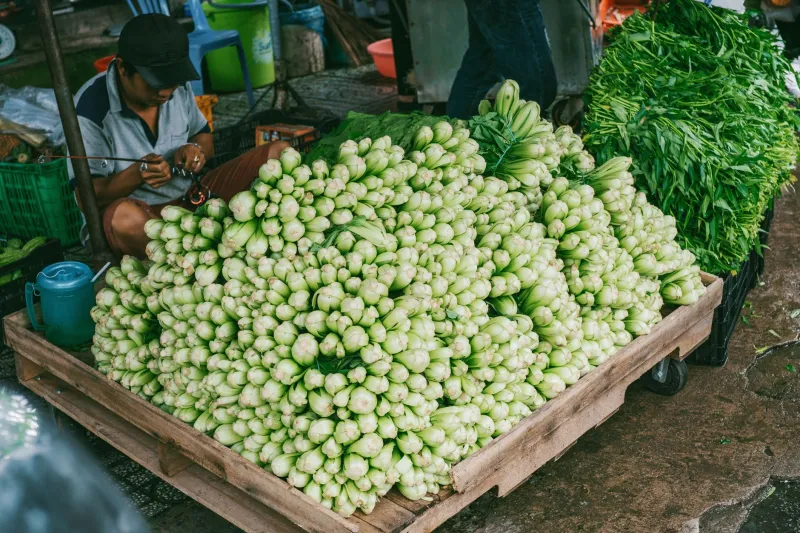
Homestays and vacation rentals with full kitchens offer something hotels fundamentally can't: the ability to cook. And cooking in — especially with ingredients sourced from local markets — is almost always the lowest-impact food option available to travelers.
It also tends to be one of the most memorable parts of a trip. There's something about shopping at an unfamiliar market, figuring out what's in season, and improvising a meal in a kitchen that isn't yours that feels genuinely adventurous. Travelers who do this regularly describe it as one of the most immersive ways to experience a place.
The carbon math is straightforward: food cooked at home generates fewer emissions than restaurant meals (which involve commercial kitchen energy use, food waste at scale, and transportation) and far fewer emissions than delivery (which adds vehicle miles on top of all of the above).
A Practical Guide to Eating Thoughtfully on Your Next Stay
Before you arrive: Search for the nearest farmers market and note its hours. Look up whether there's a food co-op or independent grocery within walking distance of your accommodation. If you have dietary restrictions, do this research early — it's harder to find local options when you're hungry and in an unfamiliar place.
Day one: Make a market run a part of your arrival ritual. Even if you only pick up coffee, fruit, and something for breakfast, you've set a pattern and gotten a feel for what's locally available.
When you do eat out: Look for restaurants that name their suppliers on the menu. It's an imperfect signal, but it's a real one. A restaurant that lists the farm their pork comes from is almost certainly more connected to the local food economy than one that doesn't.
With delivery apps: If you're going to use them, at least filter by locally owned restaurants. Most apps now let you do this. It's not perfect, but it's meaningfully better than defaulting to a chain.
Talk to your host: Seriously. This one keeps coming up because it keeps working.
The Bigger Picture
Food is culture. It's economy. It's ecology. What you eat on vacation is a series of small decisions that, aggregated across millions of travelers, shape whether local food systems thrive or wither.
You chose a homestay because you wanted something real. The food you eat while you're there can be part of that realness — or it can be the same delivery-app loop you could run from anywhere. The choice, like most things in conscious travel, is genuinely yours.