Where Does Your Travel Money Actually Go? The Uncomfortable Truth About Big Booking Platforms

Let's talk about something most travel blogs won't touch with a ten-foot pole: the economics of where you sleep.
You've probably noticed that booking a place to stay has never been easier. A few taps, a saved credit card, and boom — you've got a beachside apartment in a neighborhood that used to be full of families and is now, quietly, full of tourists. It feels seamless. Convenient. Maybe even like a deal.
But convenience has a cost, and it's usually paid by someone who doesn't have a say in the transaction.
The Leakage Problem Nobody Talks About
In economics, there's a concept called "tourist dollar leakage" — the percentage of money spent by travelers that flows out of the local economy rather than circulating within it. In developing coastal destinations, that leakage rate can run as high as 80%. That means for every $100 you spend, only $20 might actually stay in the community you visited.
Mass booking platforms accelerate this problem in ways that aren't immediately obvious. When a property management company — often headquartered far from the destination — lists dozens of units on a major platform, the profits from your nightly rate travel straight to investors, corporate landlords, and platform shareholders. The local neighborhood gets foot traffic, noise, and rising rents. It doesn't necessarily get much else.
A 2019 study published in the Journal of Sustainable Tourism found that in several Caribbean coastal towns, the rapid expansion of short-term rental platforms correlated directly with the displacement of long-term residents, the erosion of neighborhood social fabric, and — critically — a net decrease in money reaching local small businesses. Tourists were staying in the neighborhood but eating at chain restaurants, booking tours through app-based aggregators, and spending at shops owned by outside investors.
The neighborhood became a backdrop. Not a community.
What Actually Happens When You Stay With a Local Family
The math works completely differently when you book a genuine homestay with a family who lives there year-round.
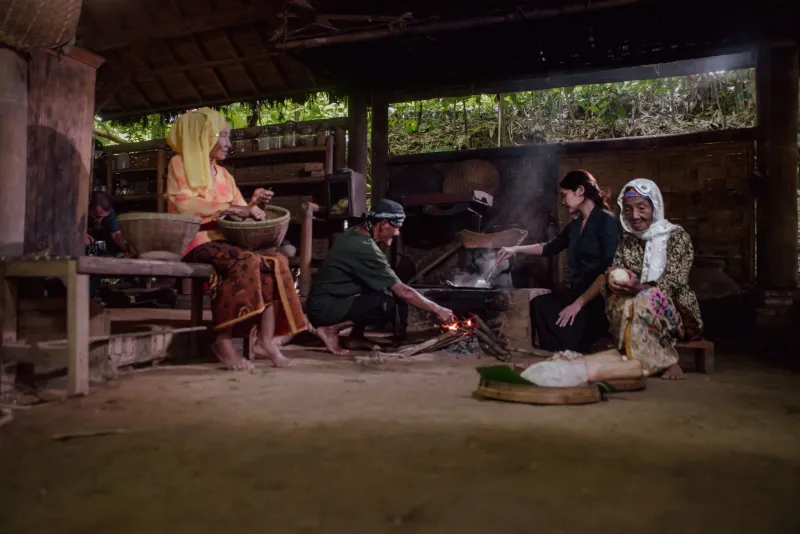
Take the Mendoza family, who host travelers in their coastal home near a working fishing village in the Yucatán. When guests book directly, 100% of the accommodation fee stays with the family. Breakfast is sourced from the neighbor who keeps chickens two streets over. The guided reef snorkel is run by the eldest son, who is also studying marine biology. The handwoven table runners in the guest room were made by a cousin who sells her work through the family's network.
Your nightly rate doesn't just pay for a room. It pays for school supplies, boat maintenance that keeps a fishing livelihood alive, and the kind of reef stewardship that no government program has adequately funded.
This is what economists call the "multiplier effect" in action — money that stays local gets spent locally, and then spent locally again. Studies suggest that every dollar spent at a locally owned business generates two to three times more economic benefit to the surrounding community than the same dollar spent at an absentee-owned property.
The Neighborhood Transformation Nobody Signed Up For
Barcelona. Lisbon. New Orleans. Sedona. The story is familiar by now, even if we don't always connect it back to our own booking habits.
When short-term rental platforms flood a desirable neighborhood, rents rise — not just for tourists, but for the people who actually live there. Teachers, nurses, fishermen, and artists get priced out. The bodega that's been on the corner for 40 years closes because the owner's lease tripled. A vacation rental management company moves in. The neighborhood starts to look like a theme park version of itself.
In New Orleans' Tremé neighborhood — one of the oldest African American neighborhoods in the country and the birthplace of jazz — researchers at Tulane documented a significant acceleration in resident displacement following the rapid expansion of short-term rental listings in the mid-2010s. The cultural community that made the neighborhood worth visiting was being pushed out by the very tourism it attracted.
This is not an abstract policy problem. It's a direct consequence of where travelers choose to book.
The "But I Read the Reviews" Defense
Here's a fair pushback: plenty of people booking on major platforms think they're supporting local hosts. And sometimes they are. There are genuine, owner-occupied listings on every major platform, run by real people who live on-site and depend on the income.
The problem is opacity. Platforms don't make it easy to distinguish between a family renting out their spare room and a property management company running 47 units under 12 different host names. Reviews tell you whether the WiFi worked. They don't tell you whether your host is a local grandmother or a shell LLC registered in Delaware.
Conscious travelers have to dig a little. Look for hosts who respond personally, mention their family or their neighborhood with specificity, and offer the kind of local knowledge that only comes from actually living somewhere. Or better yet — book through platforms and networks specifically designed around verified local family hosting, where the vetting has already been done.
What Conservation Has to Do With Your Booking Choice
For travelers who care about coral reefs, coastal ecosystems, and the communities built around them, this isn't a side issue. It's central.
Many of the world's most important marine ecosystems sit adjacent to communities that are simultaneously the best positioned to protect them and the most economically vulnerable. When those communities are destabilized — when families get displaced, when local fishing knowledge disappears, when young people leave because there's no economic future — the informal conservation networks that have sustained those ecosystems for generations start to unravel.
Homestay hosts with a long-term stake in their community have every incentive to protect the reef, the mangroves, the watershed. An absentee property management company optimizing for nightly rate does not.
Your accommodation choice is, in a very direct sense, a conservation choice.
A Different Way to Think About "Value"
The cheapest nightly rate isn't the best deal if the real cost is paid by a community that loses its character, its residents, and its ecological stewardship capacity.
Staying with a local family costs roughly the same as many platform listings — sometimes more, sometimes less. But the value proposition is entirely different. You get genuine hospitality, local knowledge that no algorithm can replicate, meals that didn't come from a commissary kitchen, and the knowledge that your travel dollars are doing something real.
You also get a better trip. Full stop. The most memorable travel experiences almost universally involve actual human connection — a family teaching you to make something, a host pointing you toward a beach that isn't on any map, a conversation over coffee that changes how you think about a place.
That doesn't happen in a managed short-term rental optimized for five-star reviews and frictionless checkout.
The Bottom Line
None of this is about vilifying a specific app or platform. It's about asking a question that the travel industry would rather you didn't ask: Who actually benefits when I book this?
If the answer is a distant investor and a platform taking a 15% cut, maybe it's worth looking a little harder. The families who open their homes to travelers — who share their tables, their stories, and their corner of the world — are the ones keeping communities whole.
That's worth booking for.