Staying Put Is a Political Act: Why Booking a Homestay in a Climate-Threatened Town Might Be the Most Meaningful Trip You Take
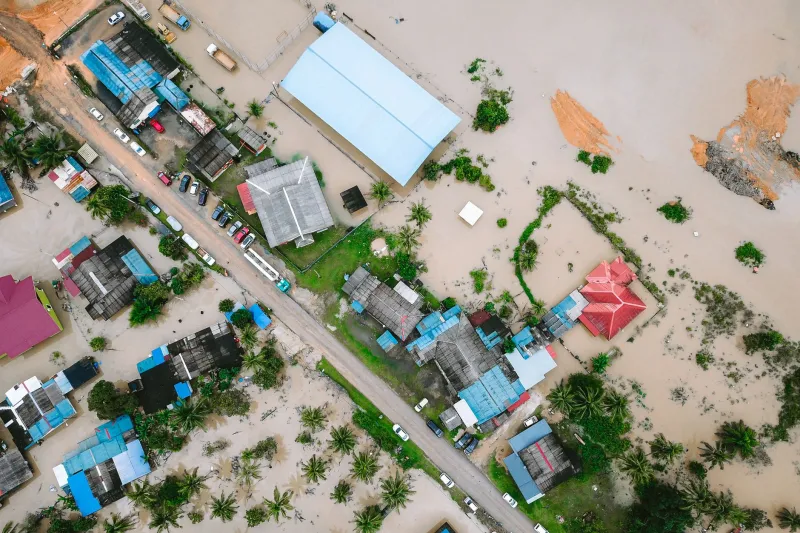
Let's be honest about something the travel industry doesn't say out loud very often: some of the places you most want to visit are in the process of disappearing. Not dramatically, not all at once — but incrementally, measurably, in ways that the people who live there track with a kind of quiet grief that doesn't make it into destination guides.
The barrier island town where storm surge now reaches streets it didn't touch fifteen years ago. The high desert village where the well levels have dropped three feet in a decade. The Louisiana fishing community where the land is literally sinking, a few millimeters per year, into the Gulf. These places are still beautiful. They're still worth visiting. And right now, the decision to visit them — and how you visit them — carries more weight than it ever has.
The Economics of Staying Versus Going
When a coastal town in North Carolina starts losing residents to climate anxiety — when families who've lived there for four generations start wondering if they should sell and move inland — what often tips the balance toward staying is economic viability. Can we make a living here? Can our kids? Can this place sustain itself?
Tourism dollars are part of that calculation. But not all tourism dollars work the same way. A traveler who books a chain hotel, eats at a corporate restaurant, and buys souvenirs at a gift shop attached to a national brand is spending money in a place without really investing in it. The revenue leaks out — to corporate headquarters, to out-of-state ownership, to platforms that skim a percentage off every transaction.
A traveler who books a homestay with a local family, eats at the restaurant the host recommends, and buys directly from the farmers market is doing something structurally different. The money stays. It compounds. It becomes the thing that makes it possible for a family to repair their porch after a storm, or invest in a rainwater collection system, or simply decide that staying is still worth it.
What Hosts in Threatened Communities Actually Say
Maria runs a small homestay on the Outer Banks of North Carolina, in a town that's watched three neighboring properties get condemned since 2018. She started hosting partly out of economic necessity after her husband's fishing income became unreliable — the fish populations have shifted, the seasons are off, and the fuel costs to follow them are higher than they used to be.
"People come here and they see the beauty," she says. "They don't always see what it takes to keep it. Every guest who stays with us instead of the big resort down the road — that's money that goes back into this house, this property, this community. It's not charity. It's just where the money actually lands."
In the Florida Keys, where saltwater intrusion has already compromised freshwater supplies on several islands, homestay hosts have become some of the most vocal advocates for municipal water conservation infrastructure. Several hosts there have installed greywater recycling systems and rainwater cisterns — investments partly funded by the steady income from conscious travelers who seek them out specifically because of their environmental commitments.
"My guests ask about the water situation," says one Key West host who asked to remain anonymous. "They want to know what we're doing. And having that conversation, having someone from Ohio or California actually care — it keeps me going. It reminds me this isn't just our problem."
The Seawall Calculus
Here's something that rarely gets talked about in travel media: in many climate-vulnerable coastal communities, the decision about whether to build or reinforce protective infrastructure — seawalls, living shorelines, elevated roads — comes down in part to projected tax revenue. Communities that are losing population and losing economic activity have less to spend on adaptation. Communities that remain economically active can fight harder for their own survival.
Traveler spending is a variable in that equation. Not the only variable, and not a substitute for federal climate investment — but a real one. A town that can demonstrate sustained economic vitality has more leverage when applying for FEMA hazard mitigation grants or state resilience funding. Occupancy numbers matter. Local tax receipts matter. The presence of a functioning local economy matters.
This isn't abstract. It's the math that determines whether a town gets a new living shoreline or watches its beach disappear.
What Climate Justice Has to Do With Where You Sleep
Climate justice, at its core, is about who bears the cost of climate change and who has the resources to respond to it. Frontline communities — often lower-income, often communities of color, often places whose carbon footprints are negligible relative to the damage they're absorbing — are dealing with consequences they didn't create.
When you book a homestay in one of these places, you're not solving that injustice. Let's be clear about that. But you are making a choice about whose economy you participate in, whose story you show up to witness, and whose resilience you put a small amount of fuel behind.
You're also, if you're paying attention, getting educated in a way that no documentary can replicate. Sitting at a table with a host who has watched the waterline change, who has retrofitted their home, who has thought hard about whether to stay — that's a climate education you carry differently than one you read about.
How to Find These Stays and Vet Them Well
Not every homestay in a climate-vulnerable area is actively contributing to community resilience. Some are just in a place that happens to be at risk. Here's how to find the ones that are doing the work:
Ask directly about environmental practices. Hosts who are engaged with their community's climate challenges will have something to say. Hosts who aren't will give you a vague answer about recycling.
Look for participation in local conservation or adaptation efforts. Does the host mention local land trusts, watershed groups, or shoreline restoration projects? Are they connected to regional climate initiatives?
Check where their food and supplies come from. A host who sources locally is keeping money in the local economy. That's climate resilience in practice.
Favor longer stays. A week with one host is better than three nights each in three different places. Longer stays reduce your travel footprint and create more meaningful economic impact for a single household.
The Most Important Thing You Can Bring
Awareness. Not pity — awareness. The communities fighting hardest to stay afloat in the face of climate change aren't asking for sympathy. They're asking to be seen as viable, as worth investing in, as places that deserve to exist.
Showing up — actually showing up, staying in someone's home, eating their food, walking their streets, listening to their stories — is a form of that recognition. It's not enough on its own. But it's not nothing, either.
In a moment when so many climate-vulnerable places are trying to decide whether they have a future, the travelers who choose to stay somewhere that matters might be the ones who help tip the answer toward yes.