Cast Iron, Clay Pots, and Clues: How to Read a Host Kitchen Before You Ever Taste a Bite
There's a moment that happens in almost every good homestay. You walk into the kitchen for the first time — maybe you're grabbing a glass of water, maybe your host is already at the stove — and something clicks. The smell of something slow-cooked. A rack of spices organized in a way that makes no alphabetical sense but clearly means something to the person who built it. A cutting board worn smooth from decades of use. You don't know what you're having for dinner yet, but somehow you already know it's going to be good.
That moment isn't luck. It's information. And if you know what to look for before you book, you can find it on purpose.
Why the Kitchen Is the Most Honest Room in the House
Listing photos tend to show you the bedroom, the view, the living room with the artfully placed throw blanket. The kitchen, if it appears at all, is usually a quick wide shot — stainless appliances, clean counters, nothing that tells you anything useful. But the kitchen is where a host's actual relationship with food lives. And for conscious travelers who care about eating locally, eating authentically, or just eating well, that relationship matters enormously.
A kitchen that gets used tells a different story than a kitchen that gets wiped down for photos. The difference is visible if you know what you're looking at.
The Cast Iron Question
Let's start with the cookware, because nothing communicates a cook's priorities faster.
A well-seasoned cast iron skillet — the kind that's nearly black, slick with polymerized oil built up over years — tells you your host cooks regularly, cooks at high heat, and probably learned from someone who cooked before them. Cast iron isn't a trend purchase. You don't buy it to impress a guest. You use it because it works, and because someone showed you how.
Stainless steel pans with good weight and slight discoloration around the base? Same story, different chapter. Thin nonstick pans that still have their original coating perfectly intact? That's a kitchen where cooking is more of an obligation than a practice.
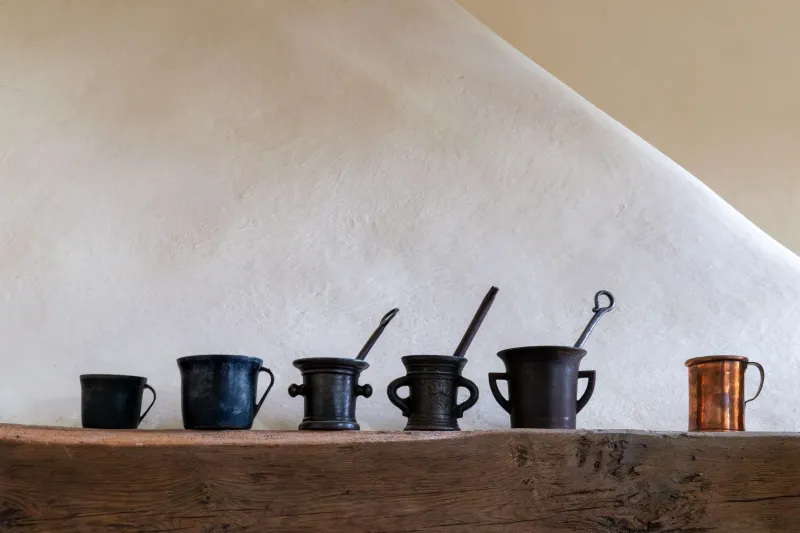
Clay pots and earthenware are their own category entirely. If your host has a clay pot — a cazuela, a tagine, a Korean dolsot, a regional piece you can't immediately name — that's not decoration. That's a commitment to a specific technique, a specific flavor, a specific tradition. Ask about it. Seriously. That question alone can open up a conversation that shapes your entire stay.
The Spice Rack Is a Map
Spice organization reveals how someone thinks about cooking. A neatly labeled rack of standard McCormick jars is fine — it means your host cooks from recipes and cooks reliably. But a collection of mismatched containers, some store-bought, some clearly transferred from bulk bins or farmers market bags, some labeled in a second language — that's a cook who sources intentionally, who has opinions about where their cumin comes from, who might be grinding whole spices before you wake up.
The presence of fresh herbs is its own signal. A pot of basil on the windowsill, a bunch of cilantro in a glass of water in the fridge, dried bundles hanging near the window — these are signs of someone who treats herbs as an ingredient, not a garnish. For travelers who care about food that tastes like somewhere, this matters.
And if the spice situation looks genuinely chaotic — containers shoved in sideways, duplicates of the same thing, a jar of something unidentifiable in the back corner — don't be put off. That's often the kitchen of someone who cooks constantly and restocks impulsively. Chaos can be a very good sign.
What the Cutting Board Tells You
A cutting board that's been used hard — grooved, stained in the corners, slightly warped from years of washing — is one of the most reassuring objects in a homestay kitchen. It means food gets prepared here in volume. It means your host isn't just reheating.
Multiple cutting boards, separated by use (one for meat, one for produce), suggest someone who cooks for people with dietary considerations and has thought about it. A single pristine board that looks like it came out of a box last month suggests the opposite.
How to Ask the Right Questions Before You Book
Here's the thing: most guests don't ask about food at all before booking, and most hosts don't volunteer much beyond "breakfast included" or "shared kitchen available." That gap is where culinary misalignment lives.
A few questions that actually help:
"What does a typical breakfast look like?" The specificity of the answer tells you a lot. "Eggs and toast" is different from "I usually make something with whatever's at the market that week." One is a service; the other is an invitation.
"Are you comfortable cooking for [dietary restriction]?" Don't just ask if it's possible — ask if they're comfortable with it. A host who says "oh, absolutely, I cook vegetarian all the time" is different from one who says "I can try" with a pause in the middle.
"Is there a local ingredient or dish you love cooking for guests?" This one is gold. If your host has a ready answer — something they're proud of, something tied to where they live — you're going to eat well. If they seem caught off guard by the question, manage your expectations accordingly.
The Freezer Test
If you get a chance to see the kitchen before committing to a longer stay, open the freezer (with permission, obviously). A freezer full of pre-portioned local produce, homemade stocks in repurposed containers, or clearly labeled leftovers from previous meals is a freezer that belongs to someone who thinks ahead and wastes nothing. A freezer full of Lean Cuisines and branded frozen appetizers is a different kitchen entirely — neither is wrong, but they're different experiences.
Why This Matters for Conscious Travel
For travelers who book homestays specifically to connect with local food culture — to eat what people in this place actually eat, sourced from where they actually source it — the kitchen is the whole point. A host who cooks with intention is almost always a host who sources locally, who has relationships with farmers or markets, who can tell you exactly where the fish came from or why the tomatoes taste like that.
That kind of cooking doesn't just taste better. It puts your food dollars into the local economy in a direct, traceable way. The cook at the stove knows the farmer. The farmer knows the land. You, sitting at that table, are part of a chain that actually means something.
Learn to read the kitchen. The story's already there.